
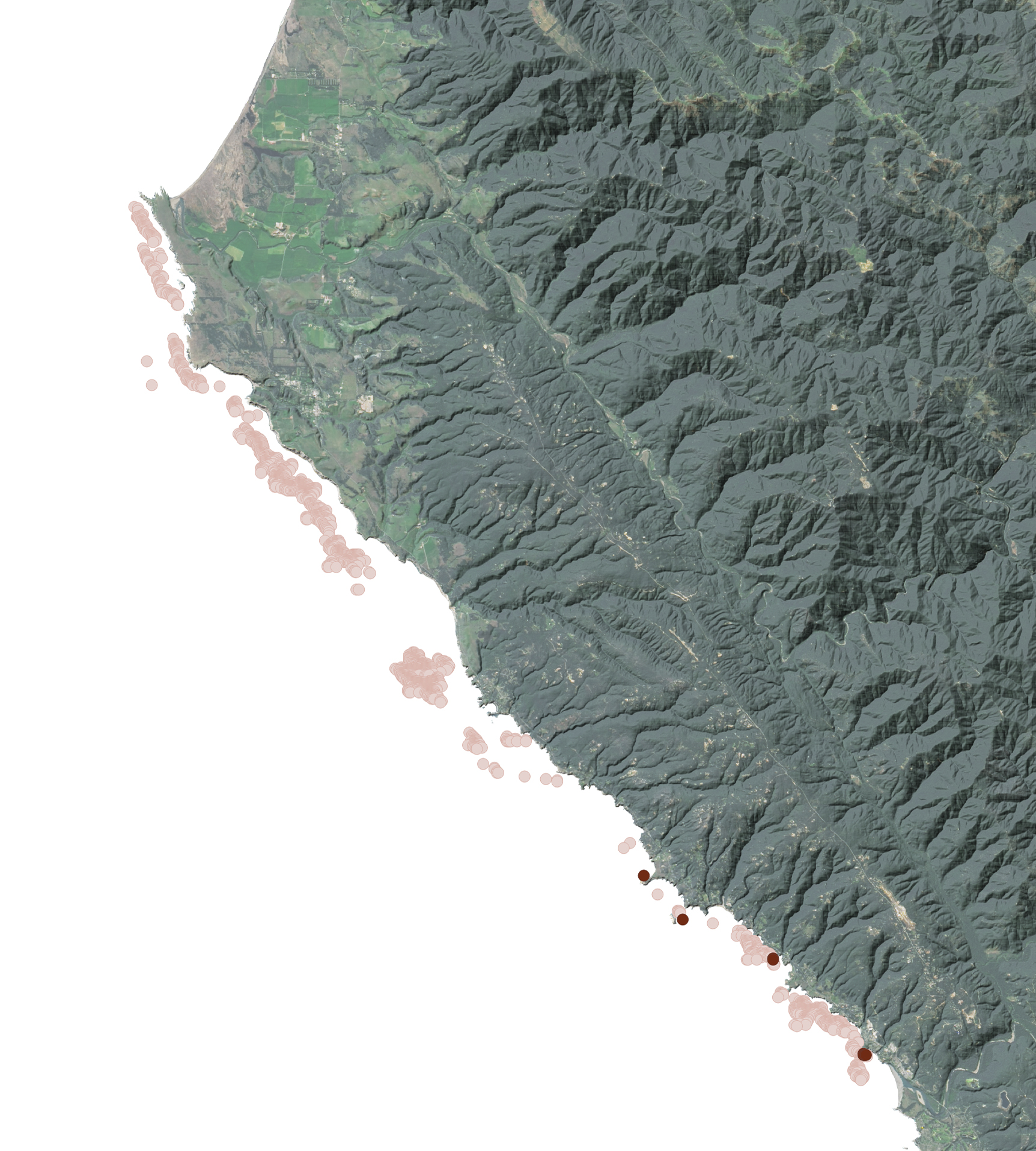
As ocean temperatures rise, kelp forests aren’t just shrinking in place: many are shifting toward cooler, higher-latitude waters, while populations at the warm edge of their range come under growing stress. A 2025 global assessment, led by researchers including Nur Arafeh-Dalmau, put real numbers on how much worse that stress is likely to get.
Using nearly four decades of Landsat and Sentinel-2 satellite imagery, the team mapped floating kelp canopy across 32 ecoregions in 12 countries, from California and Chile to Tasmania, New Zealand, France and the Falklands, and projected future marine-heatwave exposure under 11 different climate models and three emissions scenarios out to 2100.
The projections aren’t gentle: by the final decades of this century, kelp forests worldwide could face 6 to 16 times more heatwave exposure than they saw between 2001 and 2020. The Northern Hemisphere, home to kelp forests like California’s and the North Pacific’s, is projected to bear nearly double the exposure of the Southern Hemisphere’s kelp. Compounding the problem, the study found that fewer than 3% of the world’s kelp forests currently sit inside strongly protected marine areas. The authors argue that protecting the Southern Hemisphere’s relatively cooler kelp forests as climate refugia, and building “climate-smart” marine protected area networks, are among the few levers available to buy kelp time as warming continues.
Further reading: Arafeh-Dalmau, N. et al., “Global floating kelp forests have limited protection despite intensifying marine heatwave threats,” Nature Communications (2025).